Category Archives: Philosophy

The Quiet Flame

A short story in three parts

Part Three: Ella

Her name was Ella Mbaye, and she lived on the edge of what had once been a great forest. The forest was thinner now. The rivers ran hotter, and the rains came in shouts, not songs.

She was twelve years old, home-schooled, under solar lamps when they worked, and through blackout silence when they didn’t. Her mother taught her biology. Her father taught her how to fix things when there were no parts to fix them with. Ella herself liked books about stars, though they felt a long way off these days.

The world, everyone said, was tired.

Then the sky dropped something.

Continue reading

The Quiet Flame

A short story in three parts

Part Two: Maen

As we know, on the planet Orilen, there were no fossil fuels.

Not because the Orileni were wise – at least, not at first – but because their world left no remnants of the past buried deep enough to rot into fire. No coal seams. No oil fields. No gas pockets. The dead returned to the living in days, not eons.

They learned to live by the rhythms of their world: wind that pulsed, sun that danced, rivers that hummed. They shaped tools from light, built cities with air, and stored energy in coiled stone and magnetic webs.

In the seaside city of Naren-Kai, a ten-cycle-old child named Maen wandered through the spirals of her learning pod.

She was small and sharp-eyed, obsessed with broken things. While others her age sketched star-birds and coded wind poems, Maen pried open old wave turbines and rewired defunct gliders. She had questions, always questions.

One day, she found something forbidden.

Continue reading

The Quiet Flame

A short story in three parts

Part One: Serin

On the planet Orilen, there were no fossil fuels.

Not because the Orileni were wise; they simply had no choice. Their world, with its warm sapphire seas and forests of silver-needled trees, had never entombed the dead for long. Microbial life broke down the past too quickly; pressure was never right; time never still. So no coal. No oil. No gas.

For millennia, fire was a whisper. The Orileni learned to shape metal with solar furnaces made of polished obsidian and liquid lenses. Their first machines were spun by water and air, stored in stone chambers pressurised like lungs. Homes were heated not by combustion but by deep pipes sunk into the planet’s breath: geothermal warmth, constant and quiet.

Children grew up knowing the sun’s arc as intimately as their own heartbeat. Energy was not something hoarded or burned: it was something borrowed for a time.

The ‘Great Shift’ began not with an explosion, but a question.

Continue reading

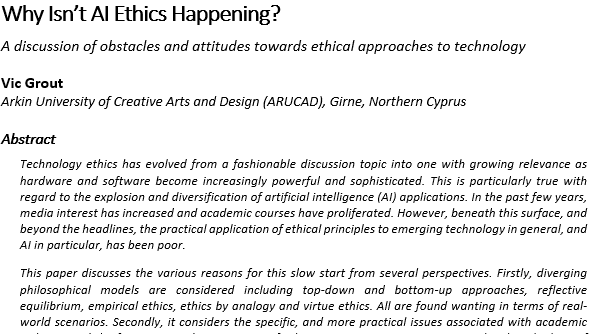
What Happens When You Submit a Paper on AI Ethics to an AI Conference?

Well, we won’t name the conference (yet)! But it takes place this month, it’s a fairly standard ‘digital communications’ affair, with this year’s focus on AI (although not exclusively).

So we submit a paper on AI Ethics …

What happens then?

Continue reading