Category Archives: Industry

How Many Computer Scientists Does it Take to Change a Light Bulb?

… and other wild and carefree – probably offensive – stereotypes.  A collection of ‘light-hearted’ (see what we did there?) thoughts and anecdotes trying to get to the bottom of what makes a Computer Scientist tick.  There may or may not ultimately be a serious point …

It’s an old one but a good one:

There are 10 types of people in the world; those that understand binary and those that don’t

(At least, it’s as old and as good as CS jokes tend to be, which may not be a long vector in either direction.)  But how much truth lies behind it?  We hear a lot about this ‘computational thinking’, for example, these days but what does it take to be good at it?  To what extent is CS ability a natural thing compared to what can be realistically taught?  How much ‘computational thinking’ does everyone need today and how much can be left to the ‘experts’?  In which case, what do we expect from the ‘experts’?  Are programmers born that way or can the skill be developed?  (Compare with artists: can you teach someone with no sense of perspective to be a landscape painter?)  How much have Computer Scientists ‘evolved’ from experts in other disciplines?  Whatever the underlying statistics might say, it does often seem that Computer Scientists are a breed apart from the rest of the world so what makes them so ‘special’?

Continue reading


Shazam for People?

When Shazam first arrived on the scene, it was pretty amazing stuff; now, we rather take it for granted.  But could the same idea soon work for people?

We know the scenario … You’re in a bar or a shop or listening to the radio or TV … or … just about anything really … and you hear a song that you either like or think you recognise or both … but you don’t know what it is.  Frustrating, isn’t it?  At least it was until music identification services such as Shazam first appeared.  After that, no worries; simply allow your mobile to listen to the music for a few seconds, search the central database and, after a few more seconds, it reports back to you with full details of the name, artist and origin.  It might even link you to a central library where you can find more of the same or possibly buy it.

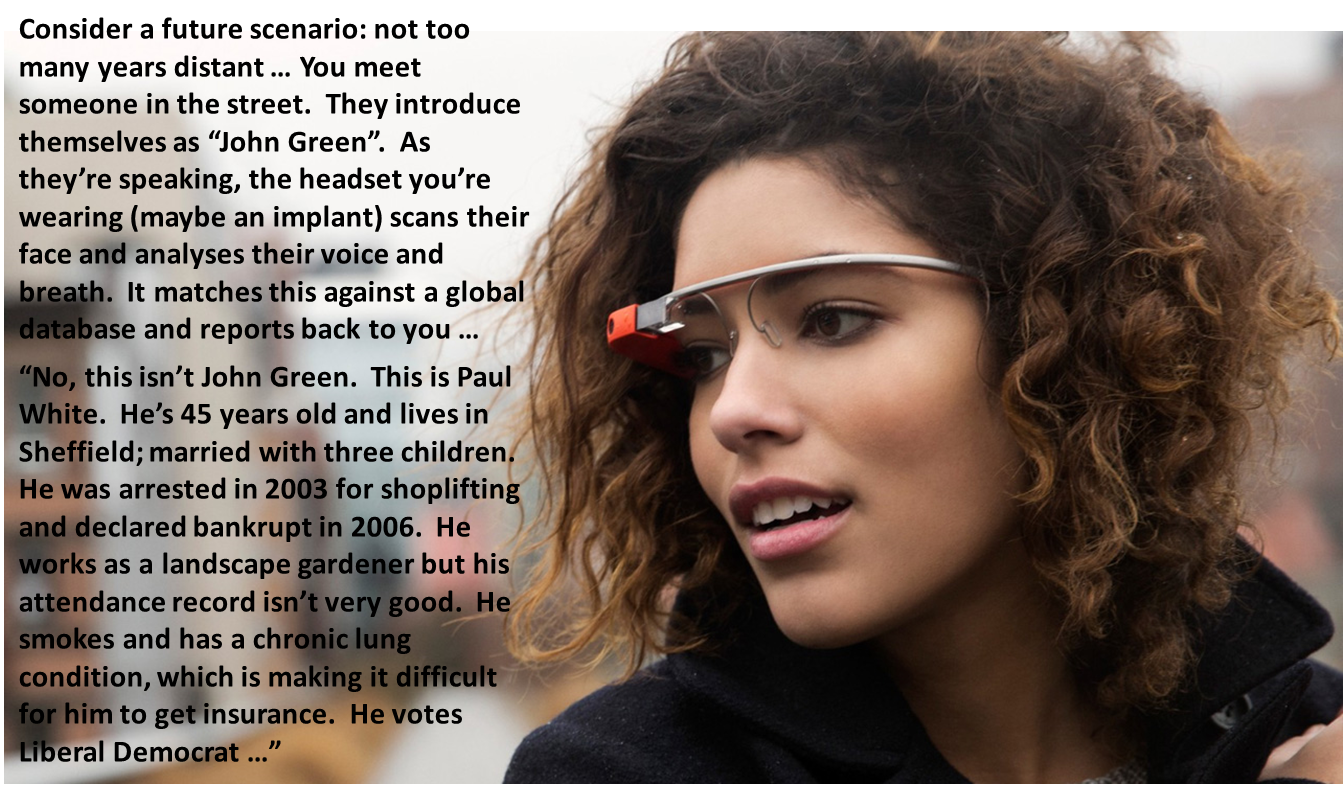
Simple enough; but, might the same principle one day work for people?  It’s really not that hard to imagine …

Picture1Accessible text version of photo

Then: “Ah, but this is only the free stuff.  If you’re prepared to pay, I can tell you a lot more about him … “

It sounds like a science fiction ‘Big Brother for Everyone’ nightmare scenario.  But could it happen?  If so, how soon? Continue reading


‘Things’ Ain’t What They Used to Be

(or “Is ‘Everything’ Going to be OK?”)

A very brief note, this one, along the lines of, “Why do we always over-hype ideas?  Even the good ones?”

So is it the ‘Internet of Things’ (IoT) or the ‘Internet of Everything’ (IoE)?  Or are they different things?  If so, what’s the difference?

Well, we’ve been talking about the IoT for some time now.  And it certainly seems to some that the IoE is just a better-sounding name for it.  Cisco though seem to have other ideas.  Here, “Cisco Senior Vice President Rob Soderbery explains how technology transitions like the Internet of Things are enabling the Internet of Everything to revolutionize industries and create value.”  Any idea what that actually means?  Nope, thought not. Continue reading


“To the Finish” … and Beyond?

Can we continue to make computing devices smaller and/or faster?  Can we do this without limit?  If so, how?  What’s the next generation?

Microchip designers use a wonderful armoury of terminology, most of it (deliberately, one suspects) impenetrable to outsiders.  However, one of the – on the surface at least – least alarming, and certainly most charming, is the phrase “To the finish”.  It’s an intriguing term and behind it is the spirit of an admirable intention.  The only problem is no one really seems to know exactly what it means.

“To the finish”, in its broadest sense, is some mythological-technological future in which logic circuits have shrunk to such an extent that individual components are measured on the atomic scale.  On one level, although in nominally different research fields, this is comparable to the “intelligent dust” predictions of the most enthusiastic Internet of Things proponents. Continue reading