
A short story in three parts
Part Three: Ella
Her name was Ella Mbaye, and she lived on the edge of what had once been a great forest. The forest was thinner now. The rivers ran hotter, and the rains came in shouts, not songs.
She was twelve years old, home-schooled, under solar lamps when they worked, and through blackout silence when they didn’t. Her mother taught her biology. Her father taught her how to fix things when there were no parts to fix them with. Ella herself liked books about stars, though they felt a long way off these days.
The world, everyone said, was tired.
Then the sky dropped something.
It fell at dusk – silent, glowing, no trail of fire. Just a soft white shimmer, like a pearl cutting through clouds. It landed in the dry creek near her village. Ella got there before the officials.
It wasn’t metal. It wasn’t hot. It wasn’t anything.
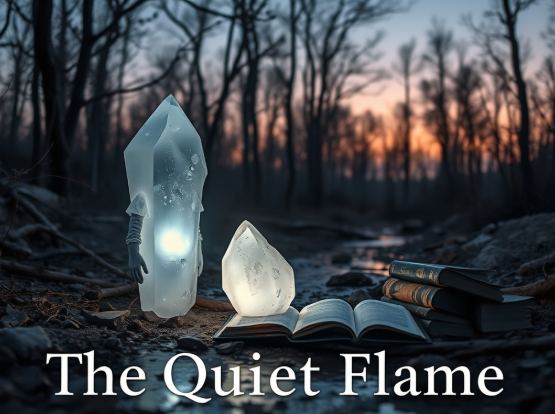
Just a smooth, transparent crystal the size of a football, cool to the touch, with strange markings etched into its shell: curves and arcs that flowed like music frozen in glass.
Inside, pulsing faintly, was a tiny symbol:
A loop. An invitation.
The scientists came. They tried drills. Scanners. Lasers. It ignored them all.
But when Ella placed her palm on its side – it opened. Not with sound or light, but a sense. A whisper of understanding. Like a dream you remembered just enough to follow.
Inside was a story. Not a voice, not text—but a narrative encoded in pattern and rhythm. It told of a planet called Orilen. Of people who had never burned their world. Who caught sun and wind and tide, weaving it gently into their lives. Who had no engines of fire, only patience and listening.
Ella didn’t tell anyone what she saw. Not at first. But she began to draw. Sketches of mirror-kites. Coiled batteries that ran on gravity. Homes made of aerogel and vines. Maps of energy that moved like water.
They called her strange.
Then they called her a prodigy.
At seventeen, Ella was invited to speak at the World Climate Triad: a last-ditch global assembly of nations trying, once again, to bargain with time.
She brought the crystal with her.
“This is not alien technology,” she said. “It is alien humility. They didn’t out-invent us: in fact, it took them longer. They just never made the mistake we did. This is a culture that never burned its own bones.”
Some delegates scoffed. Others wept. Corporations offered her obscene amounts of money to go away.
She refused them all.
“This isn’t something to sell,” she said. “It’s something to become.”
The ‘Orilen Principles’ spread first among the youth. Then engineers. Then rogue cities. Not as blueprints, but as questions.
- Can energy be shared, not hoarded?
- Can a machine give more than it takes?
- What if we never invented fire, but needed light?
By the time Ella turned twenty-five, coastal nations had launched a new orbital project: not for mining, not for weapons, but to return a message.
In low Earth orbit, the first signal from Earth was transmitted:
“We listened. We are trying. We are learning. Thank you.”
It was wrapped in one symbol:
On Orilen, Maen – now aged and grey and tired – stood once more in the observatory ring, where the stars were always whispering.
Her apprentice turned to her. “What was that?”
Maen smiled.
“An echo.”
THE END




 Turing's Radiator
So what do you think?