The Ins and Outs of Robot Sex

This post is not for the faint-hearted or easily offended. With the First International Congress on Love and Sex with Robots taking place in Portugal this week, once again, many of the key issues relating to emerging technology extend well beyond the purely technological …

Without labouring on detail, there’s a certain type of spiritual confession, which takes place all over the world, in which past sexual conduct is a major aspect.  Some crude advice often given to those (males, in this case) about to confess is along the lines of, “Don’t worry – I’ve heard it all before. In the end, there’s only five things you can really have sex with: a man, a woman, a child, an animal and a milk bottle.”  So … in the AI simulated world of the future, does that taxonomy still work?  Is an android sex-machine still a milk bottle or something more? Continue reading

Top 10 Dos and Don’ts of Google Glass

With Google Glass becoming more widely available, at least in its developmental form, here’s a list of top tips, learned from practical – and sometimes painful – experience …

OK, so you’ve given in to the hype and got your hands on a Google Glass set.  Now, what are you going to do with it?  Well, whether you just intend to have fun or you’ve serious development in mind, here are a few pointers for getting the best from the kit … and avoiding the worst:

FIVE DON’Ts

  1. Never take the set of the box unless you’re fully clothed. (This has to be top of the list. With technology that can accidentally take a photo with a wink and post it online with a cough, you have to be very careful.)
  2. Don’t tell anyone you’ve got one. (Well, not many people anyway. Apart from the increased risk of getting it pinched, you’ll be constantly pestered by people wanting to ‘have a go’.  If you are prepared to loan it out, refer everyone to rule 1: remember, it’ll probably be your accounts things appear on.)
  3. Don’t put it on in public if you’re the slightest bit shy. (Most people still haven’t seen Glass in the flesh so you’re bound to get a large number staring at you pretty quickly.)
  4. Give Google Glass a miss if you’re remotely prone to headaches. (For some people, the problem seems to go away after a time but for many it doesn’t.)
  5. Glass might not work for you if you’re short-sighted. (You may only see a blur. Somewhat surprisingly, long-sighted people don’t seem to have much of a problem.)

Continue reading


How Many Computer Scientists Does it Take to Change a Light Bulb?

… and other wild and carefree – probably offensive – stereotypes.  A collection of ‘light-hearted’ (see what we did there?) thoughts and anecdotes trying to get to the bottom of what makes a Computer Scientist tick.  There may or may not ultimately be a serious point …

It’s an old one but a good one:

There are 10 types of people in the world; those that understand binary and those that don’t

(At least, it’s as old and as good as CS jokes tend to be, which may not be a long vector in either direction.)  But how much truth lies behind it?  We hear a lot about this ‘computational thinking’, for example, these days but what does it take to be good at it?  To what extent is CS ability a natural thing compared to what can be realistically taught?  How much ‘computational thinking’ does everyone need today and how much can be left to the ‘experts’?  In which case, what do we expect from the ‘experts’?  Are programmers born that way or can the skill be developed?  (Compare with artists: can you teach someone with no sense of perspective to be a landscape painter?)  How much have Computer Scientists ‘evolved’ from experts in other disciplines?  Whatever the underlying statistics might say, it does often seem that Computer Scientists are a breed apart from the rest of the world so what makes them so ‘special’?

Continue reading


Shazam for People?

When Shazam first arrived on the scene, it was pretty amazing stuff; now, we rather take it for granted.  But could the same idea soon work for people?

We know the scenario … You’re in a bar or a shop or listening to the radio or TV … or … just about anything really … and you hear a song that you either like or think you recognise or both … but you don’t know what it is.  Frustrating, isn’t it?  At least it was until music identification services such as Shazam first appeared.  After that, no worries; simply allow your mobile to listen to the music for a few seconds, search the central database and, after a few more seconds, it reports back to you with full details of the name, artist and origin.  It might even link you to a central library where you can find more of the same or possibly buy it.

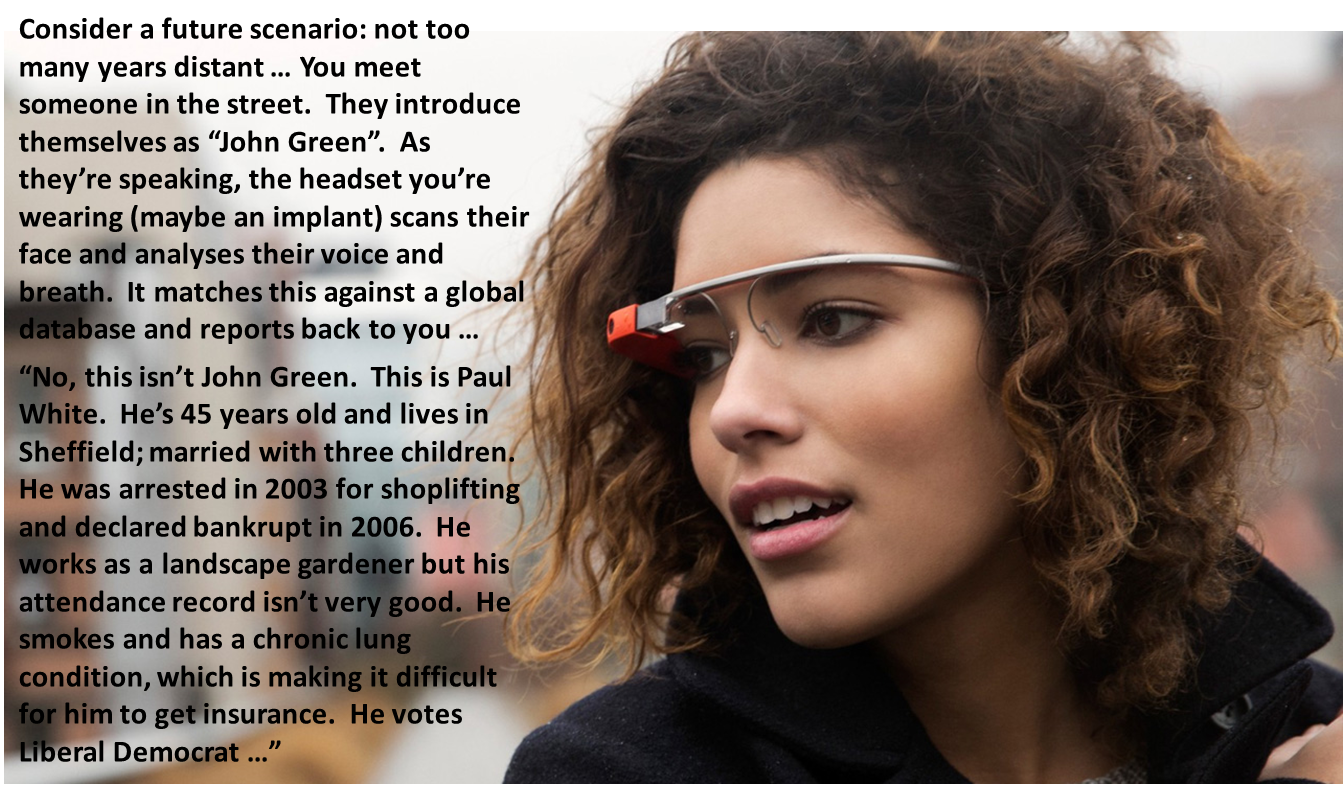
Simple enough; but, might the same principle one day work for people?  It’s really not that hard to imagine …

Picture1Accessible text version of photo

Then: “Ah, but this is only the free stuff.  If you’re prepared to pay, I can tell you a lot more about him … “

It sounds like a science fiction ‘Big Brother for Everyone’ nightmare scenario.  But could it happen?  If so, how soon? Continue reading