The Quiet Flame

A short story in three parts

Part One: Serin

On the planet Orilen, there were no fossil fuels.

Not because the Orileni were wise; they simply had no choice. Their world, with its warm sapphire seas and forests of silver-needled trees, had never entombed the dead for long. Microbial life broke down the past too quickly; pressure was never right; time never still. So no coal. No oil. No gas.

For millennia, fire was a whisper. The Orileni learned to shape metal with solar furnaces made of polished obsidian and liquid lenses. Their first machines were spun by water and air, stored in stone chambers pressurised like lungs. Homes were heated not by combustion but by deep pipes sunk into the planet’s breath: geothermal warmth, constant and quiet.

Children grew up knowing the sun’s arc as intimately as their own heartbeat. Energy was not something hoarded or burned: it was something borrowed for a time.

The ‘Great Shift’ began not with an explosion, but a question.

Continue reading
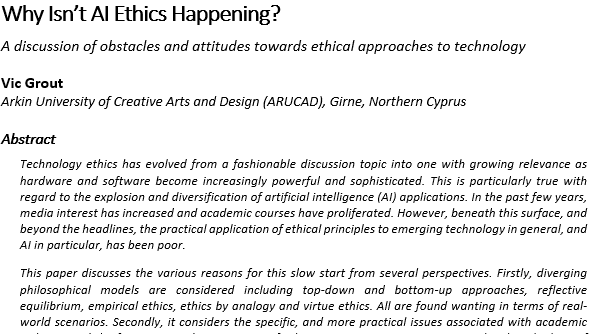
What Happens When You Submit a Paper on AI Ethics to an AI Conference?

Well, we won’t name the conference (yet)! But it takes place this month, it’s a fairly standard ‘digital communications’ affair, with this year’s focus on AI (although not exclusively).

So we submit a paper on AI Ethics …

What happens then?

Continue reading

The ‘ERIC’ Test for Strong AI

Disclaimer: This is not a universal test for strong AI!

Background

Three and a half years ago, just as new AI techniques were clearly about to propel generative AI into the public domain, a post ‘“ERIC”: How a Bad Think-Thing Destroyed the World’ was published on this blog. There was a threefold purpose:

  1. Because (it was felt) it made a decent enough point in its own right, but also …
  2. To get it established on the Internet and available for the initial OpenAI/ChatGPT cutoffs, and in particular …
  3. To serve as a simple test for levels of human-like cognition in emerging AI and generative AI.
Continue reading

ESPELETIA: The Complete Framework

In previous posts, we’ve introduced the ESPELETIA dimensions (Ethics, Society, Politics, Environment, Legislation, Economy, Technology, International and Arts) and the ‘key drivers’ (AI, IoT, Big Data, Robotics, Communications and the ‘X Factor’). We now build this into a complete futurology tool for projecting into the future, and provide a complete set of documentation for research and/or classroom exercises.

Continue reading