Category Archives: Algorithms

The Algorithm of Evolution

(Does nature ‘run programs’?  And, if it does, are the ‘algorithms’ any good?)

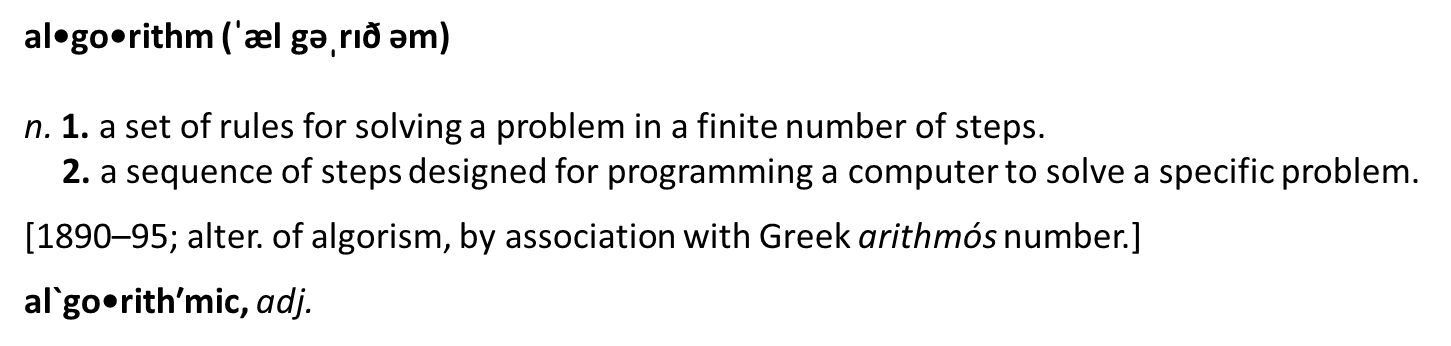
So, what is an algorithm?

Algorithm

No, not that; this is a far more fundamental question.  What IS is algorithm?  Animal?  Vegetable?  Mineral?  Ah …

OK, start with something simpler; often the first class discussion on a pure maths degree … What IS a number?  How would you answer that?  Now, if you’ve pointed at something, perhaps even pictured something, you’re wrong. Continue reading


Should We Mind the ‘Reality Gap’?

It’s generally accepted that making education ‘relevant’ is a good thing for the classroom.  Usually, this means finding practical applications for theory.  But how much of a problem is it when our ‘real world’ examples aren’t as ‘real’ as they might appear?  How important is the ‘Reality Gap’?

A universal complaint of students, whether at school, college or university, is that they often don’t see the relevance of some of the material they study.  “When am I going to be doing this in a real job?” is a typical question.  There are three broad categories of response from the teacher; bluntly and clumsily characterised as follows:

  1. “You’re getting an education that shows your capability at this level.  The content doesn’t matter.  You’ll be trained to do a particular job when you’ve got one.”
  2. “You might only use about 10% of what you’re learning now in the real world but you don’t know which 10% it’s going to be and your 10% will be different to everyone else’s 10% so we have to do all this stuff.”
  3. “Well, here’s an example of how this might be used in the real world.”

(A good teacher would add a considerable degree of finesse to these answers, of course.)  Ignoring the merits and demerits of 1 and 2 entirely, how best to achieve 3 presents some interesting challenges because, much as we might like to pretend otherwise, the real world is a terribly complicated place, in which the textbook usually only gets us so far … Continue reading

A Christmas Cracker Algorithm!

T’is the season to be jolly … and silly.  So here’s a seasonal and jolly silly example of why it’s hard to implement high-level languages efficiently.  Liberties are taken with the hardware/software relationship in some parts of the analogy but, hey, it’s Christmas!

Let’s write an algorithm for pulling a Christmas cracker …

  • Buy a box of crackers and bring home
  • Take a cracker out of the box
  • Get two people to hold an end each
  • Pull in opposite directions
  • Have fun with what’s inside
  • Clear up the mess

That’s probably going to be enough detail for most people (and more than enough for some).  However, if you’re the one that’s been entrusted with the initial purchase or the child told to do the clearing up, you might want a bit more to go on; what’s actually involved in that bit?  And who are the ‘two people’ anyway?  OK then, if needed, we can easily expand this a touch …

Continue reading


An Alternative to “Hello world!”

There’s an appreciable risk that this post may be considered sacrilegious within the programming world.  If there’s one thing, even  just one tiny, single thing, that every programmer knows about teaching programming, it’s that the first lesson should be how to output the string, “Hello world!”  (There’s some dispute as to whether the ‘w’ should be capitalised but the ‘!’ is entirely necessary.)  How heretical would it be to suggest that, not only is this probably not the best place to start, but that a better alternative can be found by turning around a bottle of shampoo?

ShampooBottle Continue reading