Author Archives: Vic Grout

About Vic Grout

Unknown's avatar
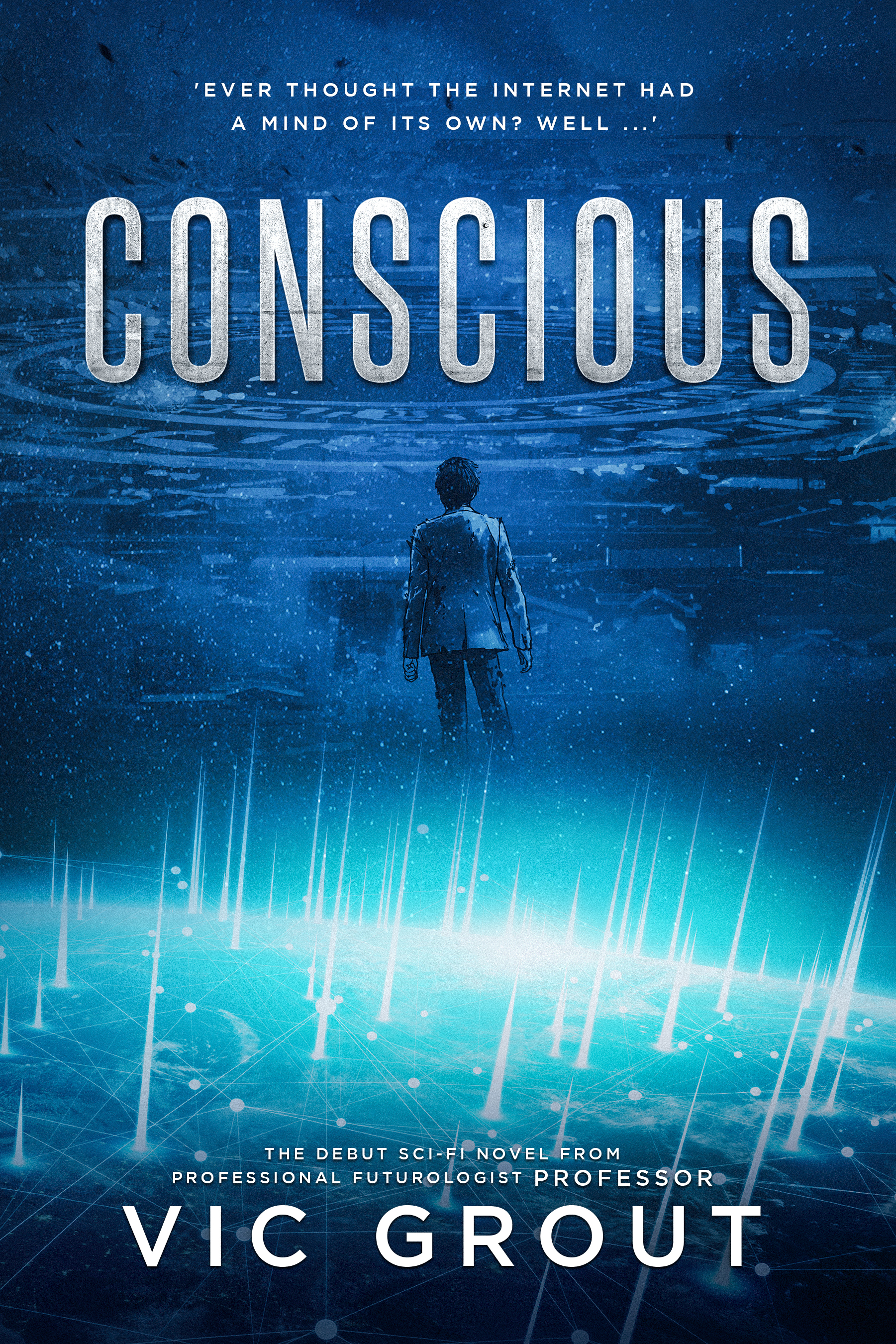
Futurist. Socialist. Vegan. Doomsayer. Ethics/Futurology Professor. Author of 'CONSCIOUS' https://vicgrout.net/the-book/

The ‘Real’ Internet of Things

(This post is derived from a talk given at the 2012 Wrexham Science Festival.)

There are so many different ways of describing the Internet of Things.  On the one hand, maybe it’s what the original Internet was always destined to be; on the other, it’s about as boring as it gets.  Tag just about anything and everything we can stick a label on, let them talk to each other, then turn the existing  Internet into a massive database of things that can be referenced, interconnected and used any which way we like.  Great if you really need your fridge to reorder the milk for you or the plants to water themselves but hardly inspirational.  Two features, however, give the proposed (and not yet fully considered) IoT a serious ‘Oooh!’ factor …

Firstly, the ever-increasing intelligence of the Internet will allow us to manipulate this data in new and exciting ways.  More and more, the evolving Semantic Web will be able to understand the information it’s working with and make the best use of it for our benefit.  Our personal and working lives are about to become completely automated and made easier by web intelligence.  Secondly, and potentially on the darker side, other hardware and software developments will extend the IoT’s reach.  Face-recognition, image-scanners and numerous other advanced detectors and sensors will soon mean that everything can be read, whether it’s deliberately labelled or not.  We, and everything we use or own, may soon become part of the Real Internet of Things (RIoT) and we might have to expect to be identified and traced in everything we do.  So what will the future will look like?  Are we heading for paradise or Big Brother? Continue reading


How to Write a Really Bad Program

(A case study in bad and good algorithm design.  Hopefully, a bit of fun for anyone in a programming frame of mind, but also serving as a useful reference for the ‘Are There Any Hard Problems?’ post that follows.)

In ‘A Scandal in Bohemia‘ (Arthur Conan Doyle, 1891), Holmes and Watson discuss the difference between seeing and observing“You see, but you do not observe [Watson]. The distinction is clear. For example, you have frequently seen the steps which lead up from the hall to this room.”  “Frequently.”  “How often?”  “Well, some hundreds of times.”  “Then how many are there?”  “How many? I don’t know.”  “Quite so! You have not observed. And yet you have seen. That is just my point. Now, I know that there are seventeen steps, because I have both seen and observed.”

Who knows; perhaps, if they hadn’t moved on to discuss more pressing issues (that King of Bohemia has a lot to answer for), Holmes may have set Watson something a little more interesting:  “How many of these steps do you generally take in a single stride, Watson?”  “I suppose one or two, Holmes, it varies; never three. Sometimes I take different combinations of one and two steps as the mood takes me”  “Excellent, Watson; another challenge! So, taking these steps one or two at a time, in any combination you wish, how many different ways are there of climbing the seventeen steps?”  “Well, I’m quite sure I don’t know, Holmes; rather a lot, I would imagine!” Continue reading


Dawn of the Intelligent Machines?

(The second of two posts distilled from a talk given at the 2011 Wrexham Science Festival. The first part, ‘The Singularity is Coming … Or Is It?‘, appears separately.  However, both have a common thread and share some material.)

It seems that the next few decades may give us something really remarkable: truly intelligent computers; that, before the 21st century is a half, maybe a third, old, we could be living with machines capable of genuine, independent thought.  Apparently, this is not science fiction or the ‘artificial intelligence’ of the 20th century but real intelligence.  So many questions … Can that really happen?  Will it?  How?  What does it mean?  What will that world be like?  What do we have to look forward to?  Or to fear?  How do we get from here to there … and do we want to?  How does today’s AI technology develop into tomorrow’s thinking machine?  What will we do with it when we’ve got it?  What happens if we get it wrong?  Can we ultimately build something ‘better’ than us?  Will we be served by teams of intelligent robots or is there a risk that we could end up serving them?  Or, as we and the machines both evolve, will the ‘natural’ distinction between human and computer eventually become blurred and ultimately unimportant?  Pause for breath … Continue reading


The Glorious Gödel

This might seem a bit off-track but a blog inspired, even loosely, by Alan Turing, can hardly not mention Kurt Gödel.  In simple terms, it could be said that Gödel was to Mathematics what Turing was to Computer Science but even that’s a pretty one-dimensional portrayal.  Both were intrigued by what was possible in science and mathematics and both shed light on how one area of research could be used to model another.  Turing’s work with the patterns of nature has parallels with Gödel’s models of the universe.  Both were intent on considering the ‘bigger picture’, whether spiritual or part of a ‘master program’.  Turing saw order in chaos; Gödel saw God in science. Continue reading