Category Archives: Software

Technology Changing the World? It’s time for the regular reminder …

There’s a UK general election on Thursday 12th December.  Perhaps a once-in-a-generation chance to steer the country away from fascism?  The stakes are high and the issues numerous (yes, really, more than just Brexit) but here, we’ll try to keep to the technology.  However, ‘keeping to the technology’ is as much to do with understanding what it can’t and won’t do, just as much as what it can and will …

Some of this isn’t new in this blog but it seems to be a timely reminder.  Let’s start with a simple (rhetorical) straw poll:

  1. Can we all agree that the next few years are going to bring some interesting technological developments?  Yes?
  2. Can we generally agree that those ‘developments’ can be loosely described as ‘advances’?  Hmm?  Not quite so certain?  Depends on your point of view?  Maybe?  Possibly?  Most of the time?  Probably?
  3. Are we generally confident that emerging/future technology will benefit people?  Ah!

Which people?

This is at the heart of it.  Yes, technology changes lives.  Yes, it has the potential to make lives better.  But will it?  and for whom?
Continue reading


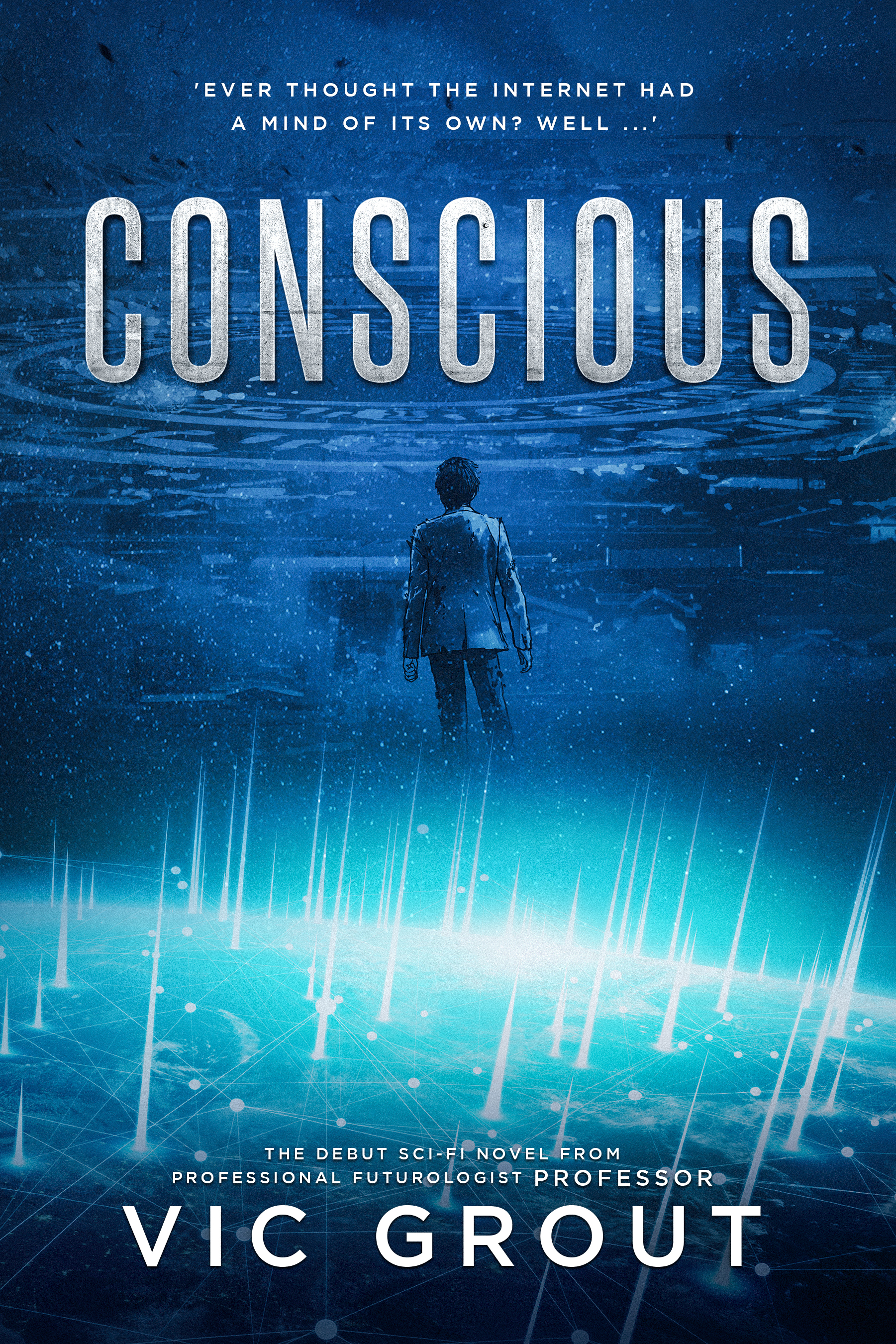
New edition of ‘Conscious’

Yes, indeed, there’s a new edition of the novel!

Updated slightly to reflect changing world events (although, sadly, all the initial predictions are pretty much coming true now).  And with a swish new cover!  Just search for ‘Vic Grout Conscious’ on Amazon in your region (and choose the one with the cool blue cover) or use the direct links below.

Enjoy!


Turing Test for Dogs

A good, punchy, witty reminder from Existential Comics that most people who drone on about the ‘Turing Test’, particularly news reports that some new software has ‘passed the Turing Test’, have never even read, let alone understood, Turing’s original 1950 paper.

Just to recap on a few essentials:

  • The ‘Turing Test’, even by today’s common interpretation, relies on a human decision-maker, whose sophisitication in recognising AI presumably increases with the development of AI itself.  It isn’t precise enough to be a ‘test’.  It never was a ‘test’.
  • Turing himself, never proposed any ‘test’, merely an illustrative game to compare impressions of intelligence.
  • The figures Turing gave were a prediction of what might be possible, not a benchmark for passing any ‘test’.
  • There is no ‘Turing Test’.

Read the paper!


Can AI Get Too Clever?

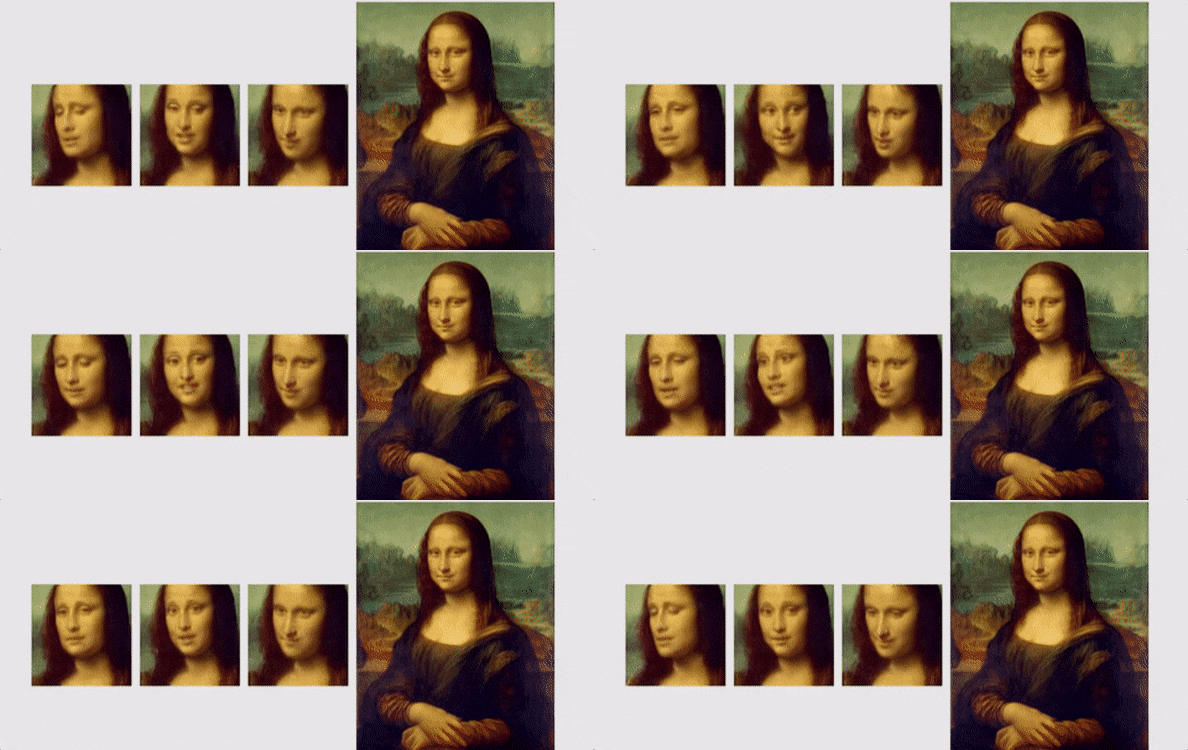
No, we’re not talking technological singularity; something a bit more down to earth: just good old fashioned fake news really but with a new twist. A fairly, short, simple, not terribly deep piece this month, but combining with what’s gone before to lead to next month’s proposition broadly along the lines of “Is it possible for a race to ‘stupid’ itself into extinction?”

In an early original episode of Star Trek, Jim Kirk gets into trouble when some recorded video evidence is falsified, appearing to show negligence. As the storyline unfolds, it’s generally accepted that few people would have had the necessary expertise to do this, which eventually points the way to the falsifier. In fact, this concept continued to turn up in many Star Trek series and films as the years passed.

At the time (of the initial episode), in the real world, of course, such an idea would have been almost unimaginable. Back then, it was hard to credibly manipulate still photographs, let alone moving pictures. And it’s hard to say if many people were even speculating so far as, “I wonder how long it will be before we can do that?” Really, it was just bonkers.

But we’ve come a long way.

Continue reading