Category Archives: Computer Science

Do Wizards Believe in Magic?

A more-than-somewhat oblique look at the issues of trying to define machine ‘intelligence’

Two hobbits are sat in a tavern in a quiet backwater of The Shire. After a prolonged silence devoted to the appreciation of their mugs of Bucktooth’s Old Tawny, one turns lazily to the other and mumbles …

“I see the Rollyberry Magic Man’s been caught out once and for all!”
“How’s that?”
asks the other.
“Those acorns he was making appear out of thin air … Turned out he had them stuffed up his sleeves all along.”
“So, he’s a fake then?”
“S’pose so. Doesn’t surprise me though. I always had my suspicions about that bloke. Old Bill Gamwise reckons, when he made that fire appear from nowhere, he had a contraption made out of flints in his pocket.”
“Hmm, so probably all the magic he’s done has been phoney then?”
“Yep, reckon so … “

A further period of ‘reflection’ follows … Eventually …

“So, do you think there really IS any magic then?”
Continue reading


How Singular is the Singularity?

If recent headlines are anything to go by, opinion on the likelihood – and impact – of the ‘Technological Singularity’ is diverging rapidly. Is this largely because we don’t even agree on what it is?

‘Artificial Intelligence’ (AI) is certainly in the news at lot at the moment.  But so are robots; and Kurzweil’s Singularity; and machine evolution; and transhumanism.  Are these the same thing?  Are they even related?  If so, how?  What exactly should we be arguing about?  Are we worried precisely because we don’t know this stuff?

Well, perhaps to make a start, we should point out that intelligence isn’t the same thing as evolution (in any sense).  That’s obvious and accepted for ‘conventional’ life-on-earth but we seem to be getting a bit confused between the two when it comes to machines.  Developments in both may proceed in parallel and one may eventually lead to the other (although which way round is debatable) but they’re not the same thing.

Continue reading


The Travelling Santa Problem

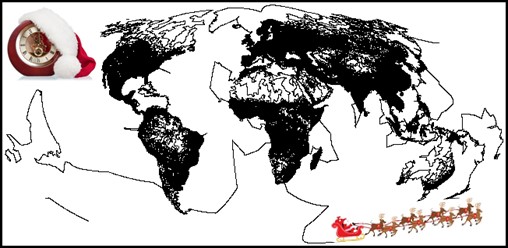
Why is the annual Father Christmas world tour ‘NP-Complete’?  What is ‘NP-Complete’ anyway?  In fact, what’s ‘NP’ even?  And why can only Santa do it?  And what’s a ‘Decision Elf’?  And just how awesome is Rudolph’s nose?  What’s ‘Inspirational Magic’?  This and so much more you didn’t know about the annual Christmas Eve ritual …

We all know the problem well enough …  Father Christmas has to travel around the world, visiting all the good girls and boys, in a single night, and return to where he started at the North Pole. Sounds like a tall order!  Can it be done?

Santa

Continue reading


How Many Computer Scientists Does it Take to Change a Light Bulb?

… and other wild and carefree – probably offensive – stereotypes.  A collection of ‘light-hearted’ (see what we did there?) thoughts and anecdotes trying to get to the bottom of what makes a Computer Scientist tick.  There may or may not ultimately be a serious point …

It’s an old one but a good one:

There are 10 types of people in the world; those that understand binary and those that don’t

(At least, it’s as old and as good as CS jokes tend to be, which may not be a long vector in either direction.)  But how much truth lies behind it?  We hear a lot about this ‘computational thinking’, for example, these days but what does it take to be good at it?  To what extent is CS ability a natural thing compared to what can be realistically taught?  How much ‘computational thinking’ does everyone need today and how much can be left to the ‘experts’?  In which case, what do we expect from the ‘experts’?  Are programmers born that way or can the skill be developed?  (Compare with artists: can you teach someone with no sense of perspective to be a landscape painter?)  How much have Computer Scientists ‘evolved’ from experts in other disciplines?  Whatever the underlying statistics might say, it does often seem that Computer Scientists are a breed apart from the rest of the world so what makes them so ‘special’?

Continue reading